Since autumn last year, volunteers have been scouting nature reserves around Sheffield and Rotherham for everything from newt eggs, to skylarks, to harvest mouse nests, and much more in between. I am one of these eager volunteers, working under the Wildlife Trust’s ‘Data for Nature’ initiative. Over my next series of blog posts, I want to share with you why getting involved with ‘Data for Nature’ was one of the best decisions I made during my time at university. Volunteering for your local Wildlife Trust is not only a vital way of helping protect wildlife in your local area, it’s also great fun to get involved with!
I initially signed up to volunteer with the Wildlife Trust because I wanted experience in ecological surveys. However, my volunteering has become more than something to write on my CV. I’ve met so many like-minded people and learnt so much more about nature. You essentially get to go walking in nature reserves, collecting valuable ecological data on the way. But, before I go off on a spiel about how great volunteering is, I should tell you what ‘Data for Nature’ actually is and why it’s a worthwhile cause to devote your time to.
What is ‘Data for Nature’ all about?

‘Data for Nature,’ funded by the National Lottery Heritage Fund, was born in response to the Sheffield State of Nature report, which stated that gaps in the city’s ecological records should be addressed. The Trust aims to improve its database of wildlife populations within Sheffield and Rotherham. To do this, the Trust has set up rigid methods of monitoring for each species and/or habitat type. These robust monitoring frameworks are taught to volunteers on training days, so they know how to carry out each specific survey type. Armed with the ‘know-how’ to complete surveys on our own, us volunteers go out en-mass to other reserves and repeat the process. All in all, this massively increases the Trust’s capacity to collect data. In the words of Julie Riley from the ‘Data for Nature’ team:
“we are developing set methodologies so that surveys can be repeated and analysed over the long term, helping the Trust to see how effective its management of each reserve is, and make changes if needed.”
The first survey….harvest mice populations
The first ‘Data for Nature’ survey began in November last year, when we searched the Carr House Meadows reserve for harvest mouse nests. In case you’ve never seen one, the harvest mouse is the smallest rodent native to Europe. Adult harvest mice can weigh as little as a 2p piece! You’ll find harvest mice from central Yorkshire southwards, scurrying in long grasses and reeds. The harvest mouse is the only British mammal to have a prehensile tail, which it uses as a fifth limb to hold on to the grass stems it feeds and breeds in. In the breeding season, harvest mice weave dome-shaped nests out of grass. These are found between half a metre and a metre above-ground in dense vegetation, out of sight of predators stalking the grounds below.

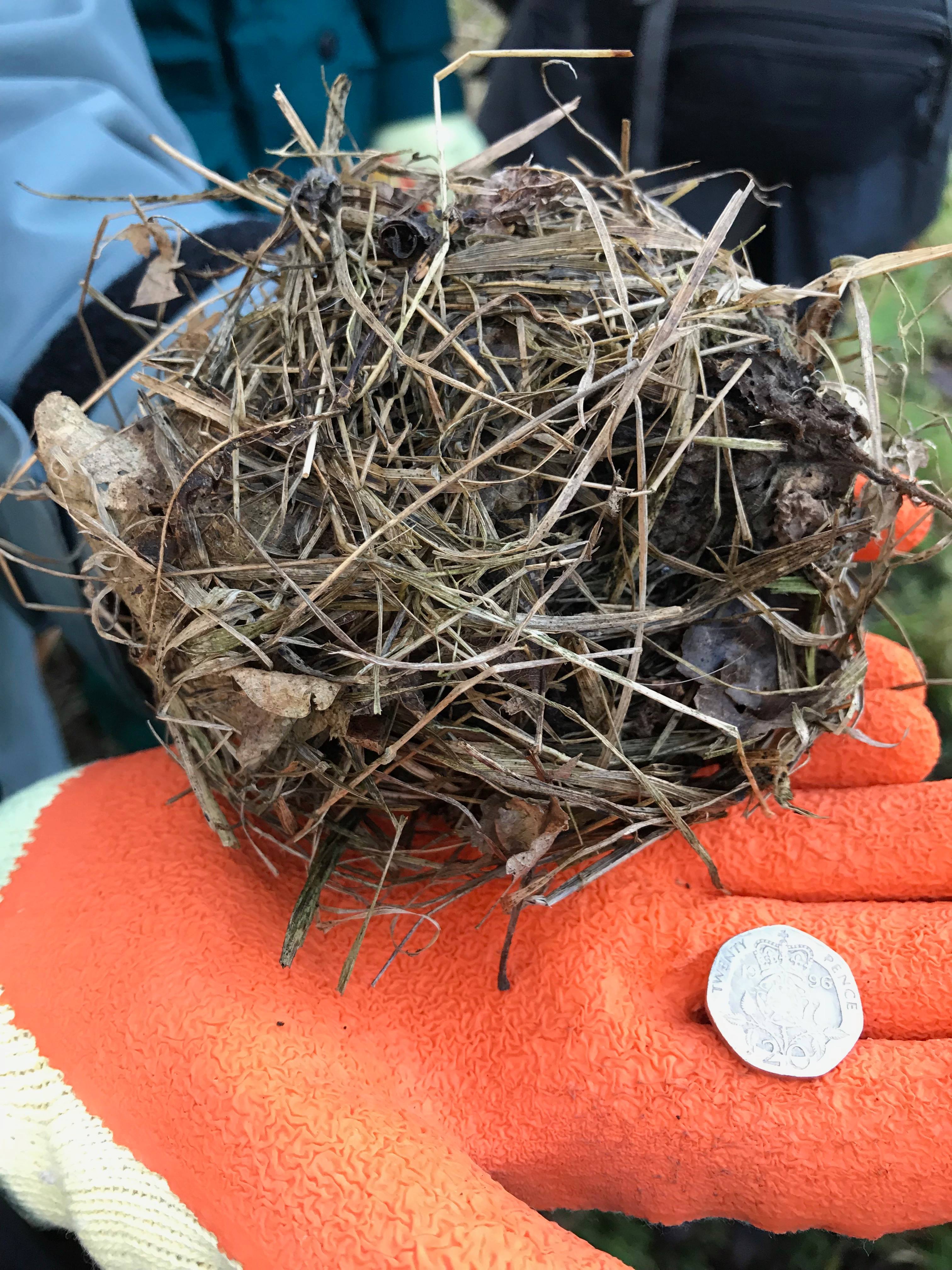
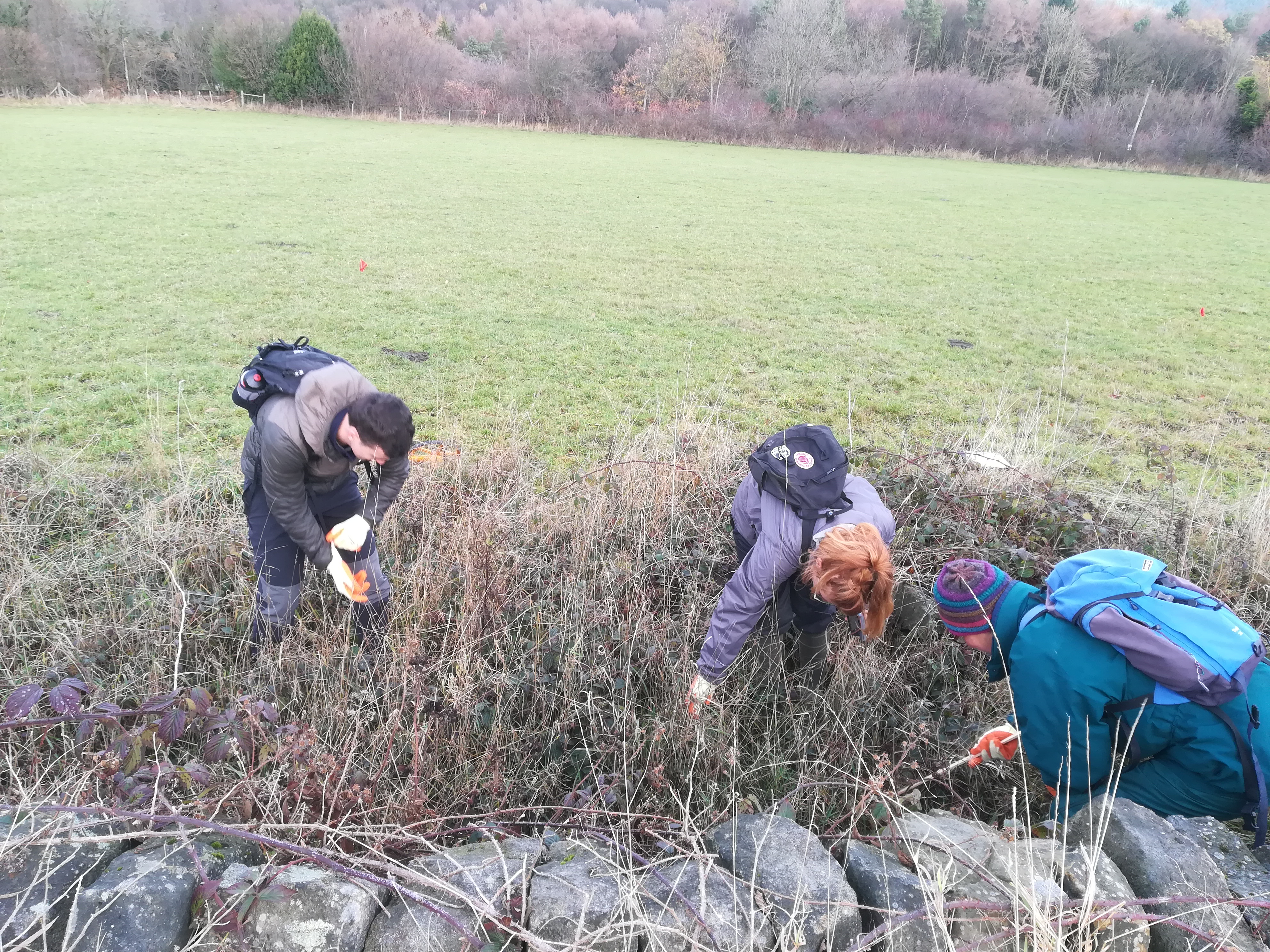
In this survey, we systematically searched for nests as an indicator of harvest mouse presence. Searching for mice themselves would be too time consuming and, unlike mice, nests don’t move, so you have a much higher chance of finding them! The Carr House Meadows reserve is divided up into a series of fields. We searched the perimeter of each field, where the vegetation is taller and denser. We moved around the perimeter taking quadrats of a given area. Within each quadrat, we measured:
- Whether or not 50% of the vegetation was over 0.5 metres tall.
- How well connected the area was.
- The dominant plant species in the area.
- The presence of any harvest mouse nests.
Why did we measure these things?
These aspects of the reserve were measured to assess how suitable it is as a breeding habitat for harvest mice. For example, the minimum height a harvest mouse likes to build its nest above ground is around 0.5 metres, so assessing whether of not more than 50% of the vegetation is at least this height allows us to see whether there is substantial tall grass available for the mice to nest in. A suitable breeding habitat would also be well connected to foraging grounds by dense grasses or shrub margins. This allows mice to move between their nest and foraging sites through dense grasses, which best obscures them from predators. We also identified the dominant plant species in the area to see which vegetation best supported nesting. In our training session, we were shown how to identify common grasses and shrubs in the reserve. We were also taught how to identify harvest mouse nests as some bird species, like reed warblers, construct similar looking spherical nests. This training was very useful when we did come across nests which turned out to belong to birds rather than harvest mice. When we found a suspected harvest mouse nest, photos were taken and sent to a mammal expert at the Trust who confirmed the nest’s identity.
The results…
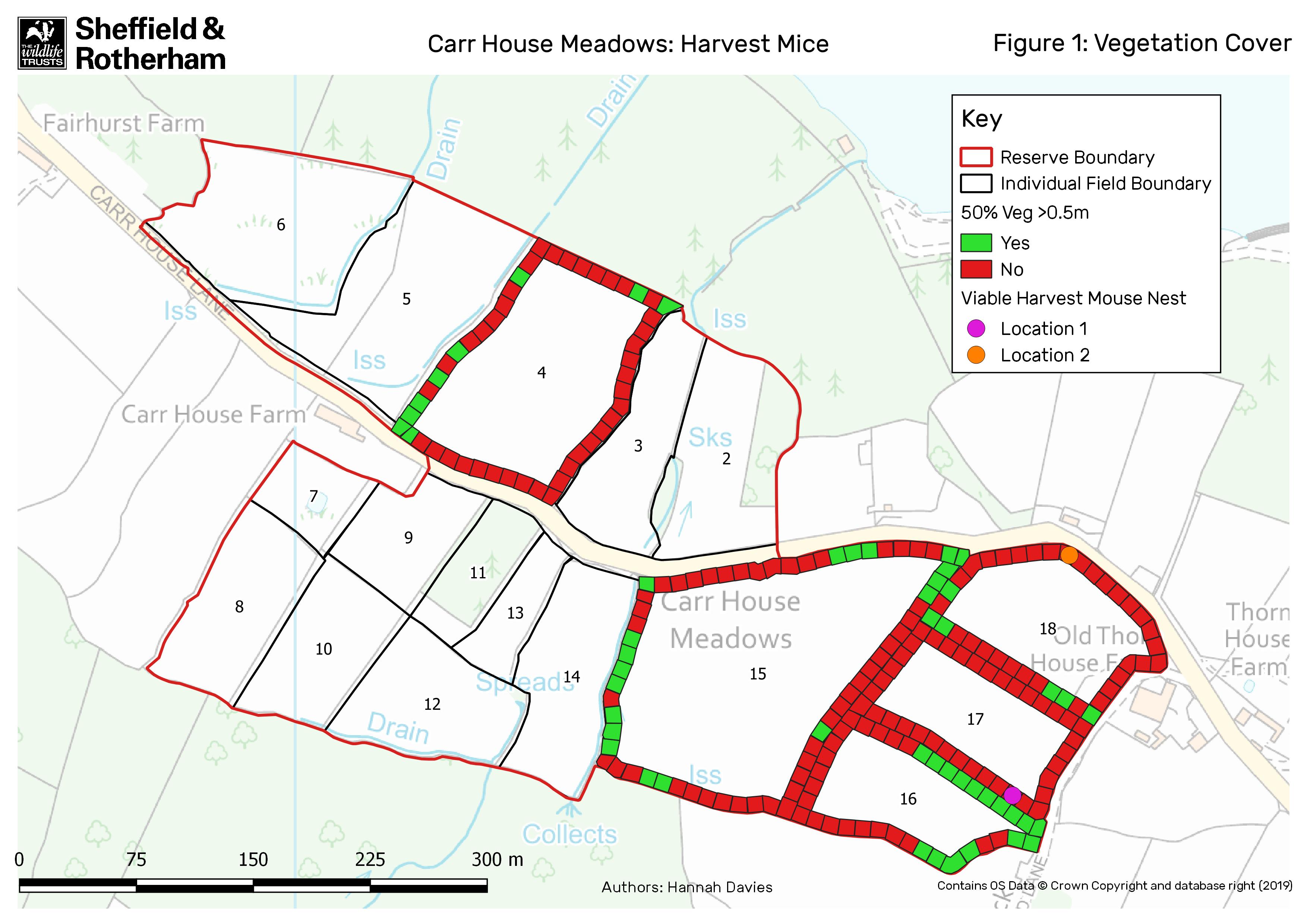
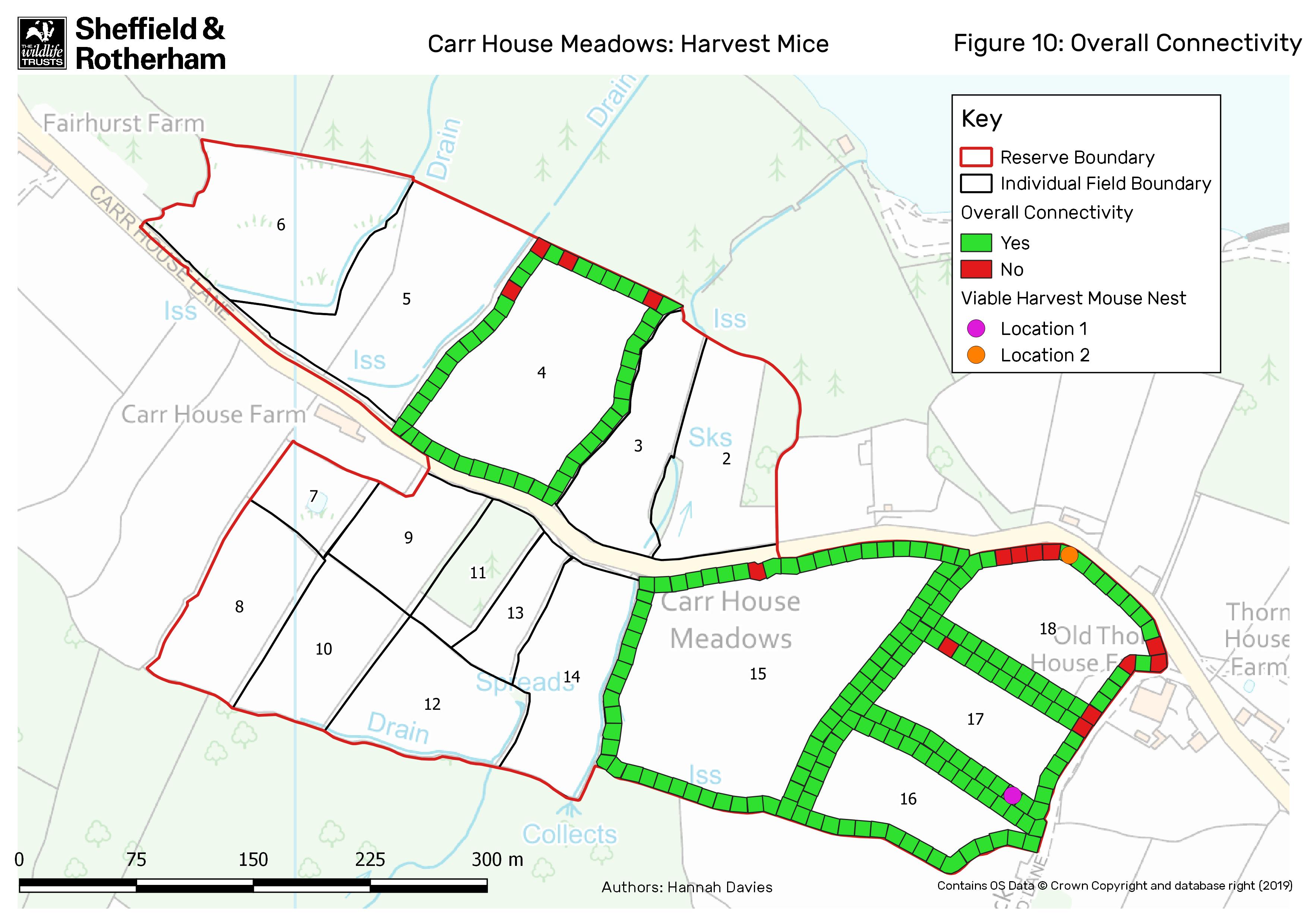
We were excited to find two nests at Carr House Meadows. Though two doesn’t sound that impressive, this gives us great hope that the reserve does serve as a suitable breeding habitat for harvest mice. These maps, produced by Hannah Davis, show the locations of these two nests. The first map shows the results for our vegetation cover analysis. This indicates that 50% of the vegetation cover in the quadrats neighbouring the nests was not greater than 0.5 metres. This is surprising, considering the typical nesting habits of harvest mice. The second map shows the results for the overall connectivity of the quadrats neighbouring the nests. Both nests seem relatively well connected, particularly the nest in location one. This initial analysis suggests that connectivity may be more important to a harvest mouse choosing a nesting site than vegetation cover. Pete Tomlin from the ‘Data for Nature’ team suggested we may only have found two nests in the reserve because there is not enough rough grass cover around the field edges to allow easy movement. This makes sense, as harvest mice need nesting sites to be well connected to their feeding grounds by dense grasses, allowing predator evasion during foraging. Increasing the rough grass cover around the reserve perimeter may be crucial in encouraging population growth. The final map shows the results for the dominant plant species around the nest. Our two nests seem to have a lot of bramble in neighbouring quadrats, suggesting this is a good plant species for the nests to be hidden within.
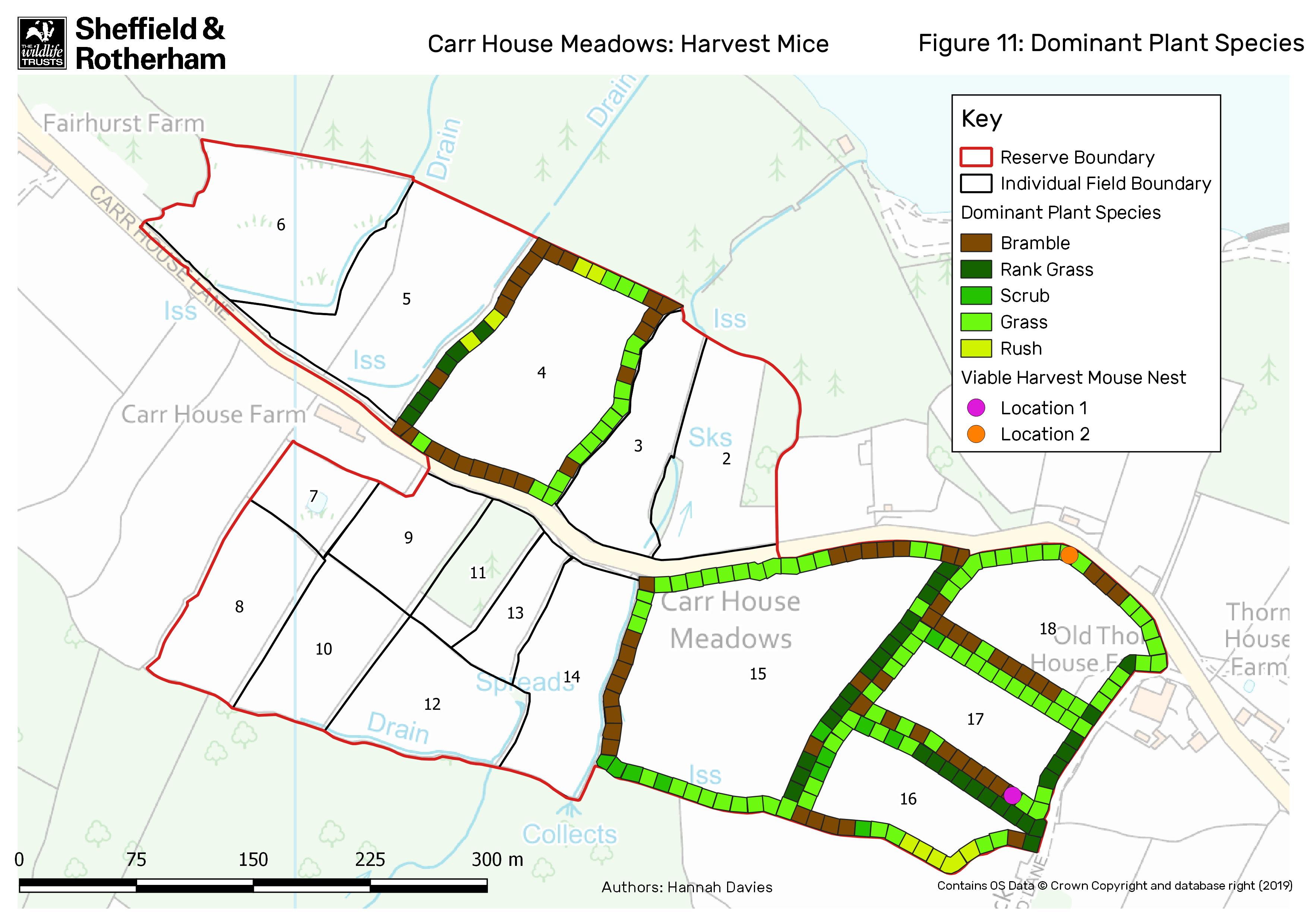
Since the survey at Carr House Meadows, ‘Data for Nature,’ volunteers have tried out the protocol at another reserve: Woodhouse Washlands. A full survey is due to take place this autumn. It will be interesting to see if results seen at this second site are similar to the results above. Importantly, these results will give the Trust the opportunity to make changes to the way these reserves are managed. This should involve increasing connectivity, so more harvest mice use the site to breed in the future.
Scavenging the hedgerows for harvest mouse nests in this first survey for ‘Data for Nature’ made me eager to get out and do more. If, like me, you enjoy digging around in hedgerows, ponds and woodlands, sign up to volunteer with your local Wildlife Trust.
You can learn more about ‘Data for Nature’ and volunteering here: https://www.wildsheffield.com/wildlife/wildlife-conservation/data-for-nature/
Check out this page for more information on harvest mouse ecology: https://www.wildlifetrusts.org/wildlife-explorer/mammals/harvest-mouse
Find out more about Carr House Meadows here: https://www.wildsheffield.com/reserves/carr-house-meadows/
 Bees, Trees & Curiosities